
Press release from the World Heritage Council
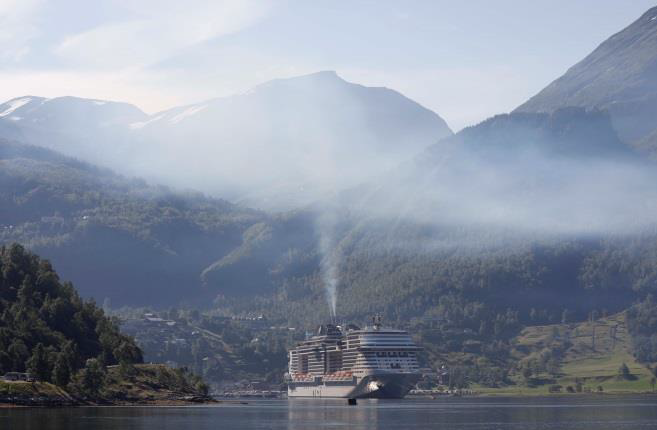
MSC Meraviglia (ship launched 2016), 16 July 2018 Geiranger Fjord
Western Norwegian fjord landscape represented by the Geirangerfjord and Nærøyfjorden with the surrounding area was inscribed on UNESCO's list of world natural and cultural heritage in 2005. The World Heritage Council for the Western Norwegian Fjord Landscape has as its primary task to work to safeguard and promote the World Heritage status awarded to the Geirangerfjord and Nærøyfjord areas jointly.
Pollution in the World Heritage fjords must be eliminated
The World Heritage Council for the Western Norwegian Fjord Landscape welcomes stricter regulation in the World Heritage fjords. The change in the regulations of the Norwegian Maritime Directorate for traffic in the World Heritage fjords is a milestone for the management of the World Heritage area. It is very important that environmental emissions to water and air in the Norwegian World Heritage fjords are greatly reduced and eventually completely eliminated in the years to come.
World Heritage status is a national obligation to the international community and future generations. There are great expectations that Norway will discharge this responsibility in an outstanding manner. Ever since the inscription of the natural heritage of the Western Norwegian Fjord Landscape in 2005, the issue of pollution has been on the agenda of the World Heritage Council from the very beginning. Weaknesses in the Norwegian management model for the World Heritage fjords were discovered early on. Stricter regulation of the World Heritage fjords is therefore absolutely necessary to combat pollution, to secure the World Heritage status, the public health of the local population and the sustainable development of the local communities and local businesses around these world-famous fjords.
The World Heritage Council wants special rules for the World Heritage fjords to avoid that the World Heritage status is threatened. No other fjords in Norway are inscribed on UNESCO's list of world natural and cultural heritage, nor are other fjords as threatened by pollution and reputational damage as our fjord landscape. This therefore requires very special measures and it is urgent to clean up. In Stortingsmelding 35 (2012-13) and 19 (2016-17) it is stated that "Norwegian World Heritage areas shall be developed as beacons for the best natural and cultural heritage management".
- It is worth noting that the international cruise industry must meet stricter environmental requirements elsewhere in the world. After another summer of blue smoke and major national media reports on the matter, we are in overtime introducing stricter regulations for the World Heritage fjords. We have every confidence that the Norwegian Maritime Authority will clean up the pollution once and for all, concludes Arne Sandnes, a committed leader of the World Heritage Council.
- We are convinced that the World Heritage fjords and Norway can take an international position as drivers of maritime climate- and environmentally friendly development. This is not just about stricter regulation, but also about creating a new space for development, concludes Hans Erik Ringkjøb, deputy head of the World Heritage Council for the Western Norwegian Fjord Landscape.
Contact information: Arne Sandnes, head of the World Heritage Council for the West Norwegian Fjord Landscape, arne.sandnes@norddal.kommune.no Tel: 976 69 990.
Hans Erik Ringkjøb, deputy head of the World Heritage Council for the West Norwegian Fjord Landscape, Hans.Erik.Ringkjob@voss.kommune.no Tel: 971 38 720.